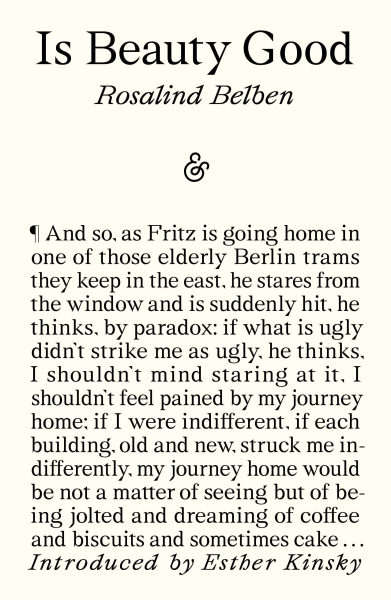
Is Beauty Good by Rosalind Belben
Published: The Toe Rag, October 2026
Rosalind Belben’s novel Is Beauty Good explores the moral stakes of beauty, yet Belben resists even defining the term, showing us what it is by saying what it’s not. She deconstructs age-old understandings of aesthetic value: for her, beauty isn’t to be found by conquering mountains or creating some perfectly stilled vision of life. ‘Every assumption is terrible,’ comes the exasperated final line of the novel. For Belben, every claim to know what beauty is kills the thing you find beautiful. More precisely, what troubles her is the point at which apprehension becomes mastery: when to notice something is to name it, classify it, explain it, submit it to control or make a claim on it.
Belben has written eight novels since her first, Bogies, appeared in 1972. Originally published in 1989 and now reissued nearly 40 years later, Is Beauty Good takes the reader on a tour across Europe just before the fall of the Berlin Wall. Over the course of 150 pages, we are transported across a continent haunted by war, from a divided Germany, on the verge of reunification, to the Alps and the sound of cowbells, and finally to Belben’s native England and its pristine, manicured gardens.
The novel is divided into three parts, further divided into thirty chapters that could be read as stand-alone short stories. Each chapter focuses on an episode from a different character’s life. Franzi, a three-year-old boy, sneaks away from home and starts pedalling his tricycle to the mountains because, he says, ‘my wheel is hungry’. Sometimes the narrative is told by a nameless English woman who likes her dogs and being outdoors. Sometimes, it is told from a different first-person perspective. Other times, an omniscient third-person narrator speaks. The different voices move in and out of dialogue, aided by the sporadic use of speech marks, giving the reader a sense of inhabiting multiple, shape-shifting identities. The novel’s formal instability is more than stylistic eccentricity: it suggests a kind of shared consciousness, in which individual thoughts exist in relation to one another rather than in isolation or conflict.
The novel is almost unquotable. Extracted from their context, quotations don’t convey the experience of reading the book. Belben writes in dissociative streams, sentences occasionally running the length of three pages, held together through a cascade of commas. Themes and ideas emerge through disconnected thoughts and roving, recurring images spread across the book. When we think we understand beauty, it’s gone, free for us to search out again. There is a dreamy familiarity between the book’s different stories. The final section begins with an epigraph from the German medieval lyric poet Walther von der Vogelweide: ‘O woe these years of mine / no telling where they flew / Has my life been dreamt / or has it all been true?’ Events, characters and places reappear in different forms. Readers go from a chapter titled ‘Daffodils’ to another about a dog called Florus. Horses move in and out of the narrative, elusive creatures, easily spooked, never fully under human control. ‘One learns to cast one’s authority from living with horses, not dogs, with horses one doesn’t win,’ says the narrator.
Is Beauty Good could be read as a reaction against claims to moral and intellectual authority. Fritz, a soldier stationed in Berlin, seeks to reinforce his own assumptions about life and art rather than test them: ‘Since I’, ‘if what is’, ‘shouldn’t’. For him, life’s mysteries are to be solved by hard-headed science. Our susceptibility to art and literature is explained away as an evolutionary habit, an instinct for survival: ‘If we are so susceptible to what we perceive as beautiful, and to what we perceive as offending that sense, is beauty good?’ Belben contrasts Fritz, who lays claim to the universal ‘we’, with the woman he spots through his binoculars from a ‘tower above a dirty white wall’. She is ‘that woman’; her views on the world are particular to her. ‘That woman,’ he says, entranced, ‘has thought in the train about horses’, how they ‘seem to like a view’, ‘a kind of aesthetic appreciation of what’s around them’. Horses don’t explain, impose schemas, hold forth; they ‘stare into the distance and make contented noises with their nostrils’. Against Fritz’s all-encompassing ‘we’, Belben suggests a more particular, embodied mode of attention. ‘That woman’, like the horse of Fritzʼs imagination, appreciates beauty from where she stands, from where she finds it, not from an all-seeing, all-knowing vantage point. A horse is beautiful on its own, not because itʼs noticed, not because of the writerʼs act of noticing.
Once looking is imagined as a form of possession, the distance between aesthetic judgement and territorial conquest narrows. ‘A whole battle can be organised over a woman’s body,’ says Kai, who is performing high-altitude military exercises, ‘shoulder to shoulder with troops from other unlikely countries.’ For Kai and his comrades from newly allied nations, the mountains become breasts. ‘And foxholes. What do they remind you of?’ he says with a boyish wink. ‘In the ravine between her upper lip and lower,’ he says, ‘one must lie, […] rifle cocked on the corner, on one’s belly.’ A woman’s body is co-opted as a site for menʼs sexual pleasure, a setting for their adventurous heroics, to exercise male violence, to suffer their destructive energies for the perpetual war of his imagination. Body and landscape become interchangeable surfaces on which mastery can be rehearsed.
The novel extends this suspicion of mastery to national borders and cultural difference. Breaking up with a German boyfriend on Berlin’s Pfaueninsel, the narrator blurts out, ‘We fought you fellows, inside I shall never forget, have no desire to, long peace, am in the enemy country.’ Yet a lot of Is Beauty Good is set in the German Almen, or mountain pastures. German spelling creeps in throughout the novel, as if the narrator has been away from home for so long that she’s happily forgetting how to write in English: ‘kiel over’, ‘graughted’. Cultural exchange goes both ways. In a surreal scene, the narrator takes the ghost of German Romantic poet Friedrich Hölderlin for a drive around the English countryside. ‘You’ve brought a glorious day with you. It’s so rural!’ he cries to his host. In 1987, Belben was invited to West Berlin as a fellow of the DAAD artist-in-residence programme, staying for fifteen months, and in the novel she shows a desire to connect across the painful legacies of war. She writes from an in-between space, over and beyond barbed-wire-lined frontiers, resisting political isolation and division, trying to avoid a return to conflict and destruction by meeting with former enemies.
But Belben is no less suspicious of the idea that ‘living together’ should require sameness. In one chapter, the narrator gets stuck on a train sitting next to a bigoted old woman. It is not explicitly clear what country she is from, but the woman complains about railway staff who ‘refuse to speak our language’. She announces to the carriage, ‘These days people live together, and separate. I find that hideous’, before adding: ‘They are lovely in their own country, they should have stayed in it.’ Belben is wary of both isolation and assimilation: the question is how to live ‘together’ without treating difference itself as a threat.
From national borders, Belben moves to another kind of imposed boundary: the ordered garden. The narrator muses, ‘People become anguished about undisciplined strawberries or unswept greenhouse.’ She continues: ‘But why neatness, why order, what does it soothe in us, what is deluding us, that grass likes to end with a straight edge?’ We artificially create binaries that donʼt exist in nature. The narrator says that ‘If a poppy sieds itself in the rhubarb bed you pluck it out’. It is a weed by definition, like any plant that grows in an unwanted place. The category depends on human intention rather than anything inherent in the plant. ‘You have no doubts, do you, over which are weeds, you yank things out.’ For the narrator, though, a weed may be beautiful; it is the violent process of categorising and dividing that is ugly. For her, nature should be wild and untamed. ‘If there is a healing, it is in the water which springs out of the rocks, full of minerals, so strong it can burn on one’s cheeks.’ Nature is most invigorating when it hurts, when you see how easily it could kill you. We seem to neutralise this fear by destroying the natural world, trying to possess it, diminish its power.
A character says, observing the yoghurt pots and cigarette butts strewn along the mountain trails, ‘If beauty has a purpose, she is there for us to spoil.’ In 1989, when Belben was writing, the planet already seemed ‘weary’. The Intergovernmental Panel on Climate Change had been established just a year earlier. The warning signs were already there: ‘Has the little earth no breath left?’ the novel asks. We show our appreciation of nature by extracting ‘her milk and honey, her oil and minerals, her harvest, her capabilities’. The logic is the same one the novel has traced elsewhere: for something to have value, it must have a use. Read in 2026, the striking thing is not simply Belben’s prescience, but how little the logic she identifies has changed: value still slips easily into use, and use into extraction.
In a chapter titled ‘Daffodils’, Belben invokes Wordsworth’s ‘I Wandered Lonely as a Cloud’. The poet of the Romantic era sees ‘a crowd’ of ‘golden daffodils’, peacefully ‘fluttering and dancing in the breeze’. Belben writes: ‘We most of us see daffodils as smiling, the colour of the sun’, but they are actually ‘crying’ inside, in silence, ‘condemned to look lovely’ while they suffer humanity’s violence, ‘trampled’ on, cut and confined to hospital wards. Daffodils are themselves poisonous, and Belben writes likewise that ‘we human beings are a crowd of naughty bulbs’, ‘full of poison’. For Wordsworth, the flowers elevate his mood – ‘A poet could not but be gay’ – and increase his soul’s worth: ‘What wealth the show to me had brought’. For Belben, the flowers are brought to sadness and diminished precisely because humans notice and enjoy them. Their beauty is made valuable according to what it gives us. Her title therefore turns back on the reader: what good is our ability to appreciate beauty if, in making it ours, we kill the world we find beautiful – and the beauty we claim to value with it?