-
1
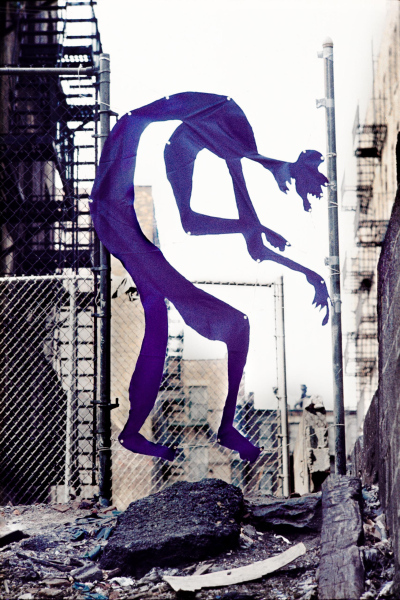
Senga Nengudi, Down (Purple), 1972
Senga Nengudi: Performance Works 1972–1982
Whitechapel, London, 1 April to 14 June
Published: Art Monthly, May 2026
This small archival exhibition focuses on a ten-year period when Senga Nengudi produced some of her most important works, including R.S.V.P., 1976. After the birth of her first child, Nengudi began thinking about the way a woman’s body stretches to near breaking point, about black wet-nurses ‘suckling child after child – their own as well as those of others – until their breasts rested on their knees’. R.S.V.P. is an evolving sculpture series made using previously worn nylon tights and pants, pulled between gallery walls and filled with sand until they can’t take any more. She initially used her own underwear, carrying them around in her bag, then, later, those from the women in her life ‘as a way of accessing the residual energy of what it means for a woman to wear these garments, the imposed tightness and packaging of one’s body’.
Inside two medium-sized rooms are two dozen wall-mounted photographs, two vitrines of flyers, posters, letters and two films of performances of around ten minutes each. The films and photos capture the atmospheric tension, of form extending into space. The posters and flyers in vitrines often point to works not found in the photographs or the videos, such as the 1980 group show in a Grand Central Station waiting room. Frustratingly, there is little explanation about these projects in this exhibition and almost nothing anywhere online, leaving you to imagine how Nengudi’s work might have engaged passersby or disrupted public space. Maybe this desire to know more, to go back in time, captures the way Nengudi’s practice resists institutional modes of knowledge and display, high- lighting what the archive cannot contain. Nengudi worked on the move, sourcing materials from thrift stores, producing ephemeral, impermanent art. As the artist and critic Lorraine O’Grady wrote in a 1993 letter on display here, Nengudi ‘can fit into a suitcase an installation more important than others can erect with earth-moving machines’.
‘The best kind of art is public art,’ Nengudi has said, adding, ‘Art is for everyone and should always be accessible.’ She started making art in Los Angeles, then, in 1971, moved to Spanish Harlem in New York, an area particularly affected by the US heroin epidemic at the time. She observed people who ‘stood like forest trees on the street corners, graceful in their highs, swaying in the wind – never falling’, bodies that had suffered extreme abuse yet never gave up on life. For her, ‘it just felt like the Black person didn’t have a chance, [...] always this gripping of death’. She was obsessed with the vocabulary of individuals’ move- ments: ‘Just as each person has their own style of handwriting, so they have a particular body language that they’re often not aware of.’ Nengudi attuned herself to the somatic rhythms of ‘all those who have been told “no” by the majority’. From the early 1970s she started making her ‘Spirit Flags’, a series of 25 textile sculptures, which she largely displayed outdoors across New York. Included here are images of the cut-out fabric outlines she created, of the ‘souls’ she saw on the street, hanging them across alleyways and fire escapes. Lit directly by the sun, the colours of the fabric are intensified, producing dramatic, cruciform shadows. Made of the same kind of lightweight nylon used to make flags, the Spirits presented an alternative image of the nation, one of heroin addicts with crushed spines and flame-like dancing figures. Blowing in the wind, these sculptures become a kind of performance, communicating a sense of the spiritual tragedy playing out in the city. For the first time in four decades, Nengudi recreated her Spirits for a 2023 exhibition at Sprüth Magers in New York, suggesting the originals were lost, or perhaps left in-situ in the 1970s and ripped to ribbons by the wind or torn down. Because of their inherently ephemeral qualities, galleries and museums have played an increasing role in keeping Nengudi’s older works alive. However, seeing the images of the New York show online, the Spirits inevitably lose something in a sanitised white cube space. They look dead.
Nengudi was initially rejected by mainstream New York galleries and museums, and first started showing at Just Above Midtown (JAM), the radical black New York art gallery founded by Linda Goode Bryant which also exhibited David Hammons, Howardena Pindell and O’Grady, early in their careers, before they were accepted by the art establishment. ‘There were no restrictions, none, related to materials [or] processes,’ Nengudi said of JAM. ‘Vibrating. That’s the kind of energy that the whole gallery had.’ Today, Nengudi is described as a ‘legendary’ perfor- mance artist, but she has rarely performed for public audiences. ‘I am very shy,’ she said in 2018 in her mid 70s. Early on, she used to do what she called ‘private performances’ in her studio, which she would get someone to photograph (some of these are included here). ‘I didn’t have an audience because the idea was terrifying to me.’
There is a video of a 2014 R.S.V.P. activation at London’s White Cube. A narrative of overcoming patriarchal oppression develops. Audience members were given small shakers. Slowly, as more join in, the sound becomes something like a mental static between everyone in the room. Maren Hassinger, with whom Nengudi has had a 50-year creative relationship, enters and climbs into a thick black wool skirt, covering her face, replacing her identity – like tights, the type of restrictive clothing women were/are expected to wear for formal occasions, for work, covering/showing the right amount of leg. Nengudi sits next to the cellist with a shaker, part of the collective consciousness of the room, while Hassinger plays the nylons like a stringed instrument, holding a length of fabric like a bow, pulling tighter and looser as the pitch of the cello goes up and down. The tights then become a birthing canal. She crawls through a gap, takes off the skirt and uses it to wipe the floor. Cradle to grave, cleaning, child rearing. Exhausted, she curls up as if sleeping, lying on her back, her legs running in the air, dreaming of weightlessness, gradually waking and gliding into a splits and then, before exiting, she removes the skirt and shakes it like a rug, turning domestic drudgery into a bodily purge.
Nengudi worked with many black artists, frequently. She co-founded the LA artist collective Studio Z with Hassinger, Hammons and Houston Conwill in the early 1970s, not long after the city’s 1965 Watts Rebellion against anti-black police brutality. The photograph Flying, 1982, shows Nengudi and a raft of artists affiliated with Studio Z. Nengudi chose to work this way, perhaps to share creative opportunities with other black artists because they were marginalised, not just by a white art world, but by a society that rendered them invisible, battling daily with violent, systemic racism. ‘Collaborating with others’, Nengudi has said, ‘allows you to really expand your thinking and to be affected by what other people are thinking,’ and, ‘if nothing else, to be social.’
Maybe it was almost impossible for black artists to exhibit alone, at least starting out, but group work also led to a new black Avant Garde in New York. Choice becomes necessity becomes choice. An atypical archive exhibition, rather than fixing meaning, this valuable show opens new possibilities in Nengudi’s work.